
The Dawn of Embodied Intelligence: The Global AI Robots Market

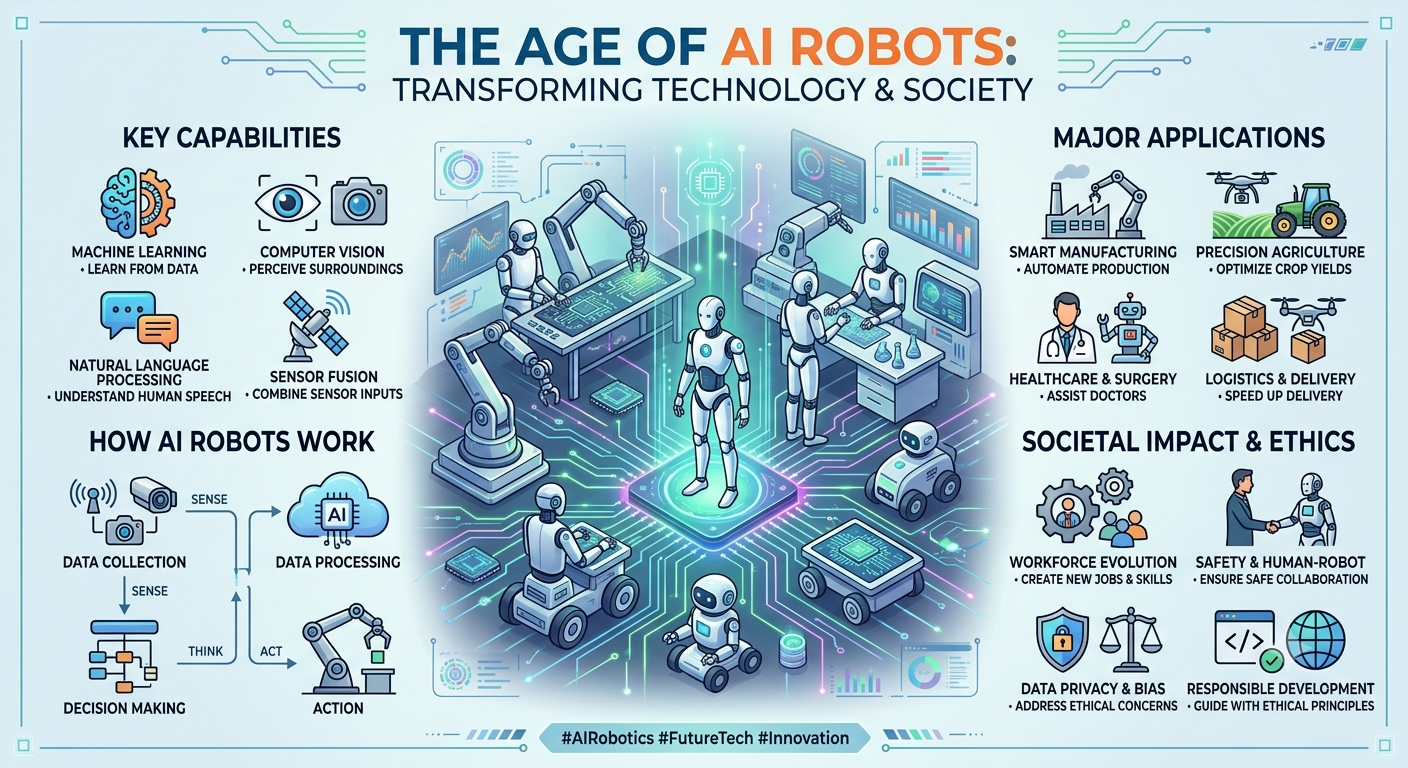
The global AI Robots Market represents the ultimate convergence of physical engineering and artificial intelligence. Unlike traditional industrial robots that follow pre-programmed, repetitive scripts, AI robots are characterized by their ability to perceive their environment, learn from experience, and make autonomous decisions in unstructured settings. This market is transforming robots from mere "tools" into "intelligent collaborators" across manufacturing, healthcare, logistics, and domestic life.
From Automation to Autonomy
The core differentiator in this market is the transition from Deterministic Automation to Cognitive Autonomy. AI robots utilize a sophisticated stack of technologies to interact with the world:
- Computer Vision & Perception: Leveraging deep learning and 3D sensors (LiDAR, ToF), AI robots can identify objects, navigate complex obstacles, and even recognize human emotions or gestures.
- Machine Learning & Reinforcement Learning: Through "trial and error" in simulated environments (Digital Twins), robots are learning complex manipulation tasks—such as picking up fragile, randomly oriented objects—that were previously impossible to program manually.
- Natural Language Processing (NLP): Service and social robots are increasingly equipped with advanced NLP, allowing them to understand and respond to human voice commands, making them intuitive interfaces for elderly care or hospitality.
Key Market Drivers: Labor Shortages and Precision Demands
The rapid adoption of AI-integrated robotics is fueled by several global macro-trends:
- The Global Labor Gap: In sectors like warehousing, agriculture, and elderly care, there is a chronic shortage of human labor. AI robots, such as autonomous mobile robots (AMRs) and robotic harvesters, are stepping in to fill these gaps, working 24/7 without fatigue.
- Mass Customization in Manufacturing: As consumers demand personalized products, production lines must be flexible. AI robots can be quickly "re-trained" for new tasks via software updates, unlike traditional robots that require expensive physical re-tooling.
- Healthcare Transformation: From AI-assisted surgical robots that compensate for a surgeon's hand tremors to autonomous disinfection robots in hospitals, AI is enhancing the precision and safety of medical interventions.
Technological Pillars: Edge AI and Swarm Intelligence
The "brain" of the robot is evolving through two distinct architectural shifts:
- Edge AI & On-Device Processing: To ensure real-time response (critical for safety), AI robots are increasingly performing heavy computation on-board using specialized AI chips (NPUs). This reduces latency and the dependency on a constant cloud connection.
- Swarm Intelligence: In logistics and search-and-rescue, "swarms" of AI robots communicate with one another to complete tasks collectively. They can optimize traffic flow in a warehouse or cover large areas of terrain more efficiently than a single unit.
- Human-Robot Collaboration (Cobots): AI is the primary enabler of "Cobots"—robots designed to work safely alongside humans. AI sensors detect human proximity and adjust the robot's speed and force instantaneously to prevent injury.
Strategic Outlook: The Rise of General-Purpose Humanoids
Strategically, the AI Robots Market is moving toward the development of General-Purpose Humanoid Robots. Companies are betting that a robot with a human-like form factor can seamlessly integrate into environments designed for humans—using the same tools, climbing the same stairs, and operating the same machinery.
Furthermore, the "Robot-as-a-Service" (RaaS) business model is lowering the barrier to entry. Instead of a massive upfront capital investment, businesses can lease intelligent robots and pay based on usage or performance metrics, accelerating adoption among Small and Medium Enterprises (SMEs).
Ethical and Social Governance
As AI robots become more autonomous, the market is facing critical questions regarding Safety, Liability, and Ethics. Establishing global standards for "Explainable AI" in robotics—ensuring we understand why a robot made a specific decision—is becoming a top priority for regulators and industry leaders alike.
In summary, the AI Robots Market is not just about replacing human labor; it is about extending human capability. By giving machines the power to see, think, and learn, we are creating a new class of digital-physical entities that will redefine productivity, safety, and the very nature of work in the 21st century.